
An interpretation is requested when it is not clear (to a designer, builder, measurer, class association or certification authority) how a class rule shall be interpreted. When an interpretation is issued it should be kept in mind that the interpretation is valid until the class rules are changed or for two years maximum only. The purpose of this last rule is that two years gives sufficient time to consider if the effect of the interpretation is a) desirable or b) undesirable. Depending on the decision or choice (a or b, by the IRSA TC or the class depending on whether there is an independent class organisation or not) the class rules can be revised accordingly.
Thus, when drafting any interpretation, it should be kept in mind how the class rules should/could be revised to make the original interpretation request redundant.
It follows that, if no revised class rule can be written, there is no need to issue an interpretation. Where no interpretation is required, but only an explanation of the effect of the class rules, it follows that it would be appropriate to deal with the original request by issuing a Q&A to be published on the IRSA website and elsewhere as appropriate.
This is the guiding principle used by the IRSA Technical Committee when considering any question about the class rules whether it is a formal request for an interpretation or not.
Robert Grubiša
11 August 2025 (based on the same Q&A issued by IRSA in the past for all IRSA classes)
IOM owner obligations after the certification control has been done and certificate issued.
IOM Class Rules are based on the ISAF Standard Class Rules (SCR) since year 2002, meaning that class rules using SCR have a common layout which will become increasingly familiar to sailors of boats big and small as time goes on. Also, starting from 2002, the IOM Class Rules make extensive reference to the ISAF Equipment Rules of Sailing (ERS).
So, the IOM Class Rules is divided into the following sections:
Section A Administration, racing rules, class rules, certification, etc.
Section B What is needed to be eligible to race
Section C Rules that apply when racing
Section D Hull rules
Section E Hull appendage rules
Section F Rig rules
Section G Sail rules
Section H Diagrams
A significant effect of this format is that only rules of Sections D, E, F and G are checked at the time of certification control (ERS C.4.2). Each section is written, as far as possible, in a way that permits the equipment covered in that section to be measured as much as possible without having the equipment in other sections available. Thus, a sailmaker can expect to find all he needs to know about the class rules in Section G and he should be able to make and measure sails without needing to know about the spars they are set on. Manufacturers should be principally concerned with Sections D, E, G and G.
Rules which apply to the way in which component parts are brought together, e.g. hull appendages and the hull, or the sails and rig, are placed in Section C. This is done because the way the parts are assembled can determine whether or not the boat complies with the rules when racing. Sailors should be principally concerned with the rules in this section as, even though the equipment may have been certified as being in class as a result of successful fundamental measurement, Section C restricts what he can do with it afterwards and while racing.
Rules which apply to the boat as a whole unit (as used for racing) are not checked at the time of the certification control. For example, there is no point checking that a jib boom counterbalance weight does not extend beyond the bow in order to issue a certificate because future compliance depends on how the boat is assembled at the race site.
Likewise, because the rules do not require the weight and position of hull corrector weights to be measured and recorded on the certificate, (they do have to be securely fixed during an event), there is no real need to weigh and float the boat at the time of the certification control.
Although the crew may alter the position of these items at any time between events, the important point is that the boat must comply with all the class rules when it races and it is up to the crew to ensure this or face the penalty.
Excluding from the certification control what appear to be the major limiting factors (length, draught and weight) in order to get a certificate may seem a little strange at first.
Event equipment measurements including checking the length and draught (in measurement tank) and weights (using adequate scales with calibrated weights) must be done as frequent as possible to raise people’s confidence that the boats are in accordance with the IOM Class Rules during the particular event.
At the end, there is nothing wrong with common practice in some IOM ICA NCAs to unofficially check the length, draught and the weight of the IOM boat “as it is” during the certification control as valuable help to the Owner assuming that the certification measurer normally has the access to the measurement tank and scale. Once again, this is unofficial check. The owner is responsible for having the boat in compliance with all the class rules when it races and it is up to him/her to ensure this or face the penalty.
IOM ICA VC Technical
11 August 2025
[Please note, all of the Q&A below are sorted chronologically – from oldest to the newest in each segment]
Question details:
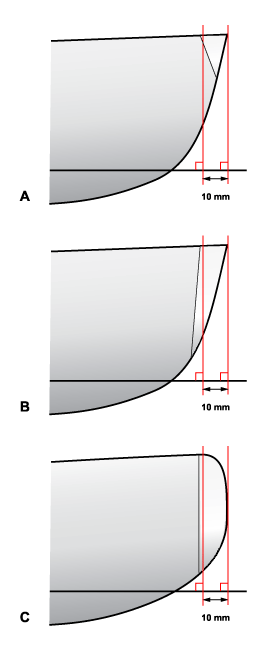
Is the bow bumper of a boat which meets the required 10 mm only at deck level and thinning towards the water line in accordance with IOM Class Rules?
Reference to the old interpretation issued before the year 2017
Interpretation 2004-IOM-3 on IOM Class Rules – edition 2003
Answers:
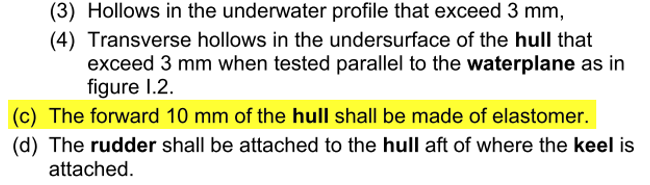
IOM class rule D.2.2(c)) is dealing with “the forward 10 mm of the hull”. Relevant ERS 2017-2020 rules are H.3.1 and H.3.4. According to them, longitudinal measurements such as “forward 10 mm of the hull” shall be taken parallel to the horizontal hull axis. Therefore the hull forward of a vertical plane 10 mm aft of the foremost point of the hull and at 90 deg. to the hull centreplane has to comply with IOM class rule D.2.2(c).
So, the bumper in diagram “A” is NOT legal, because part of the forward 10 mm of the hull is not made of elastomer. The bumpers of “B” and “C” are permitted, since all of the forward 10 mm of the hull is a bumper, even though in “B” this bumper thins out to 0 before it reaches the waterline.
Question details:
“Elastomeric” means “Returns to its original shape after elastic deformation”. There are many materials that act in this way and could be used as a bumper. What range of elastomers are permitted?
Reference to the old interpretation issued before the year 2017
Interpretation 2003-IOM-4 on the IOM Class Rules – edition 2002
Answer:
Elastomer listed in the IOM Class Rule D.2.1(a)(7) is any material that is able to resume its original shape when a deforming force is removed.
Elastic, rubber-like substances are permitted. The class rules do not set upper or lower limits on the elasticity of elastomer. When an official measurer is of the opinion that a hull contains materials that do not comply with this class rule, he should note it on the measurement form. The Certification Authority should not issue a certificate but should ask for a sample of the material.
Question details:
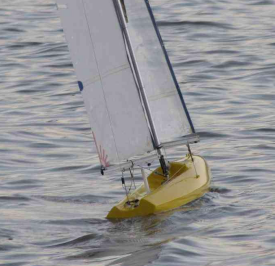
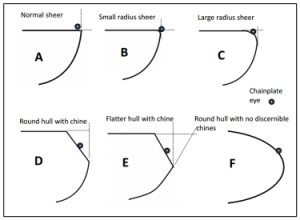
With the emergence of the new high prismatic narrow hulls with chines, the decks are becoming much narrower than traditional IOM designs. With a narrow deck, the chainplate position moves inboard and the shroud base gets narrower. I have attached pictures of a narrow IOM (see below) with rounded sides where the chainplate eye has been placed proud on the center of the topsides to widen the shroud base. See diagram F.
The question is does this contravene IOM class rule D.2.4(c) Fittings shall not project outboard of the hull shell or deck.
This question raises the issue of the location of the sheer and where the deck ends and the topsides of the hull begin. The chainplate eye can project above the deck, but cannot project outboard of the hull shell. So how do we interpret the class rule for the diagram examples B, C, D, E and F?
It also asks the question about the hull shell – is the class rule use of SHELL, referring to the plane of the hull in the area of the chainplate eye, or is it referring to max beam?
In case B, the sheer is a small radius curve and the chainplate eye extends outboard of the hull lines and max beam.
In case C, the sheer is a large radius, and the chainplate eye lies inside the max beam. There may be some questions as to where to locate the projection lines.
In case D, the hull bottom is round and the chine extends from a vertical tangential extension at max beam. The chainplate eye is outboard of the chine, but inside the max beam.
In case E, the hull bottom is a flat section and the chine extends from a wide angle tangential extension at max beam. The chainplate eye is outboard of the chine, but inside max beam.
In case F, the hull is an oval with no discernible sheerline or chines where the chainplate eye is attached. This matches the picture of the IOM (below).
Reference to the old interpretation issued before the year 2017
Interpretation 2013-IOM-1 on IOM Class Rules – edition 2013
Answers:
Relevant IOM Class Rule:
D.2.4(c) Fittings shall not project outboard of the hull shell or deck.
Relevant ERS 2017-2020 rules:
D.1.1 Hull – The hull shell including any transom, the deck including any superstructure, the internal structure including any cockpit, the fittings associated with these parts and any corrector weights.
H.3.1 – For a boat, unless otherwise specified, words such as “fore”, “aft”, “above”, “below”, “height”, “depth”, “length”, “beam”, “freeboard”, “inboard” and “outboard” shall be taken to refer to the boat in measurement trim. All measurements denoted by these, or similar words, shall be taken parallel to one of the three major axes.
Shrouds attachment points (chainplate eyes) as shown on the sketch and marked with A, C, D, E and F and shown on the photo are not projecting outboard of the hull shell and they are permitted by the IOM Class Rules.
Shrouds attachment points (chainplate eyes) as shown on the sketch and marked with B are projecting outboard of the hull shell and therefore not permitted by the IOM Class Rules.
Question details:
– micro balloons?
– bulking materials such as slate, talc etc?
Reference to the old interpretation issued before the year 2017
Interpretation 2003-IOM-4 on the IOM CR – edition 2002
Answer:
YES – in adhesives, NO – in glass reinforced plastic.
Fillers are permitted provided they are constituent parts of permitted materials listed in IOM CR D.2.1. Fillers supplied as parts of a resin for laminating or/and gel coat are constituent parts of laminating resin and/or gel coat which are explicitly mentioned as parts of the glass fibre reinforced plastic. Another filler added by the builder to laminating resin and/or gel coat is not a constituent part of laminating resin and/or gel coat.
Fillers are a normal part of adhesives and therefore permitted.
Questions details:
Question No.1: Assuming the OUTSIDE was coated with opaque or translucent paint and the inside of the wooden shell is covered with glass cloth (GRP), which is then painted with clear varnish or resin, does the construction comply with the class rule D.2.1(a)?
Question No.2: Assuming the INSIDE of the wooden shell was coated with opaque or translucent paint and the outside is covered with glass cloth (GRP), which is then painted with clear varnish or resin, does the construction comply with the class rule D.2.1(a)?
Question No.3: If both INSIDE and OUTSIDE are covered with glass cloth (GRP), which is then painted with clear varnish or resin, does the construction comply with class rule D.2.1(a)?
Question No.4: Assuming the INSIDE of the wooden shell is coated with opaque or translucent paint and the OUTSIDE is covered with glass cloth (GRP), which is then painted with coloured varnish or resin does the construction comply with the class rule D.2.1(a)?
Question No.5: If the OUTSIDE is covered with glass cloth which is then painted with coloured varnish or resin and the INSIDE is covered with glass cloth and then painted with clear varnish or resin, does the construction comply with the class rule D.2.1(a)?
Question No.6: Does a construction of a pigmented gel coat and an un-pigmented laminating resin with the hull fibres laid up whilst the gel coat was still wet comply with D.2.1(a)?
Reference to the old interpretation issued before the year 2017
Interpretation 2010-IOM-1 on the IOM CR – edition 2009
Answers:
The answer to all questions is Yes.
Question details:
Is workshop dust and other accidentally moulded in small bits like insects, air bubbles, bristles, hairs etc permitted in a moulded hull?
Reference to the old interpretation issued before the year 2017
Interpretation 2003-IOM-4 on the IOM CR – edition 2002
Answer:
Having in mind IOM class rule D.2.1, we may presume that it is normal to have some imperfections in mouldings and it is not necessary to explicitly mention this in the class rules. Their presence should be noted by an official measurer if he feels it appropriate. However this would not normally prevent the Certification Authority from issuing a certificate. The presence of particles of foreign materials not permitted by the class rules but reported on a measurement form would not be a reason for the certification authority to decline to issue a certificate.
Question details:
Is it permitted to use standard servo casings to enclose/support remote control equipment as these ‘containers’ (as stated in the preamble of the IOM Class Rule D.2.1 (a)) are made with unknown fillers?
Reference to the old interpretation issued before the year 2017
Interpretation 2003-IOM-4 on the IOM CR – edition 2002
Answer:
The casing is an integral part of the control unit. The materials used in remote control equipment are not restricted.
Question details:
The usual sticky cloth deck patch material is a dacron/terylene woven cloth coated with adhesive. Is this a film covering material? Is Dacron/terylene a permitted fibre reinforcement for this special case?
If so, are other fibres such as carbon, kevlar, which like polyester fibre, are not permitted as part of a
GRP plastic permitted as part of a film covering material?
Reference to the old interpretation issued before year 2017
Interpretation 2003-IOM-4 on the IOM CR – edition 2002
Answer:
Sticky cloth deck patch material made of dacron/terylene woven cloth coated with adhesive is a polyester fibre reinforced film covering material as permitted by IOM Class Rule D.2.1(a)(6).
Carbon and Kevlar fibres and alike in deck patch material are prohibited because they are not “polyester fibres”.
Question details:
Is it permitted to use a “Texalium” in the IOM moulding hulls?”
Reference to the old interpretation issued before the year 2017
Interpretation 2004-IOM-4 on IOM Class Rules – edition 2003
Answers:
“Texalium” is a woven, aluminium coated, glass fibre, epoxy prepeg (or not) product. Aluminium is applied on one side through a special treatment (sublimation and re-condensation in a vacuum, in a 0.025 µm thick coat) and needs the use of a specific “coupling agent” which allows good mechanical behaviour. The aluminium coat has an aesthetic function. The physical and mechanical properties of Texalium are consistent with that of a plain glass fibre reinforced plastic.
Glass fibre reinforced plastic (GFRP) excludes everything except glass fibre reinforcement and laminating resin as defined by the IOM class rule D.2.1(a)(3).
“Texalium” has internal metal content and “coupling agent” which contravene IOM class rule D.2.1(a)(3) and it is not permitted to use it in the IOM moulding hulls.
Question details:
“Thermoplastic” mentioned in IOM Class Rule D.2.1(a)(8) means “Softens when heated, re-hardens on cooling”. It is assumed that the rule permits vacuum formed hulls made from ABS PVC etc. but does it permit more materials? Are “pelletised” thermoplastics with unknown additives permitted?
Reference to the old interpretation issued before the year 2017
Interpretation 2003-IOM-4 on the IOM CR – edition 2002
Answer:
Pelletised thermoplastics are allowed for the construction of the hull if they are in compliance with the IOM class rule D.2.1(8) i.e. if containing only permitted materials
Answer:
Relevant IOM Class Rule:
Corrector weight(s) to achieve compliance with C.4.2, if used, shall be fixed in/on the hull and not be altered or moved during an event.
Relevant ERS definitions:
According to the ERS definition of corrector weight, it is the weight which needs to be installed.
ERS definition of “installation” ERS C.7.1(a) refer to bonding or fastening.
ERS definition of “bonding” ERS C.7.1(d) – To fix in place with glues, resins, sealants or other similar chemical agents.
ERS definition of “fastening” is given in ERS C.7.1(c) – To fix in place with bolts screws or rivets.
Decision
Various hook and loop fasteners (Velcro) are not permitted for installation of corrector weight(s) in/on the hull.
More info
The meaning of the wording “shall be fixed” in the IOM Class Rule C.4.3 and ERS definition of “installation” ERS C.7.1(a) is to have corrector weight(s) fixed on the dedicated position in/on the hull during an event. The use of hook-and-loop type of fasteners is not satisfying that requirement. Velcro is a trade name for hook-and-loop type of fasteners which are normally used for pieces that need to be easily separated, removable or exchanged with other items.
Use of glues, resins, sealants or other similar chemical agents and strong double-sided adhesive tapes are satisfying the requirements given above.
Corrector weight(s) in the hull shall be in the same place during an event. Between events, the owner could alter or move corrector weight(s) in order to be in compliance with IOM Class Rule C.4.2 but the corrector weight(s) shall be again fixed by glues, resins, sealants, other similar chemical agents or using strong double-sided adhesive tapes.
In addition, corrector weights used on mast spars according to the IOM Class Rule C.7.3. may be removed or added at any time, subject to IOM Class Rules C.4.1 and C.4.2.
During the equipment inspection on an event it is possible that a boat needs additional corrector weight(s) to achieve compliance with the IOM Class Rule C.4.2. Self-adhesive weights used for the balancing of alloy wheels or similar items are often used to bring the boat to the required minimum weight of the boat during an event. The owner should satisfy the equipment inspector that the self-adhesive agent is strong enough to prevent the movement of the corrector(s) weights.
Also, note that the use of hook-and-loop type of fasteners is explicitly permitted to be used for remote control equipment (IOM Class Rule D.2.5(c)). Receivers and battery cells are usually attached to the hull using hook-and-loop type of fasteners. Battery cells are often replaced during an event and could be fixed inside the hull using hook-and-loop type of fasteners having in mind IOM Class Rule C.5.4(f) i.e. they have to be refitted in the same position and replaced by the battery of similar weight.
Is an interpretation and consequent Class Rule change needed?
No.
IOM ICA Technical Subcommittee
4 May 2023
Question:
Decks on IOM boats are of complex shape including foredecks, cockpits etc. Some designs have moderate aft extensions of the foredeck in order to serve as a mast ram, to protect the switch on the vertical part of the deck or for any other reason.
Some other designs have recessed moulded parts of the deck covered with self-adhesive material or similar material.
Having in mind closed rules nature of the IOM Class Rules and that deck is not an ERS defined term is there any restriction on number of decks, aft extensions of the foredeck or any other restriction regarding the shape of the deck?
Answer:
Relevant IOM Class Rule:
Deck is not ERS defined term and the shape of the deck is not restricted/defined in the IOM Class Rules. The transverse section of the hull side and deck is defined in the I.2.
Decision:
There is no restriction on the number of decks, aft extensions of the foredeck or other restrictions regarding the shape/number of the deck(s) except those given in IOM Class Rules D.2.2 and I.2.
Is an interpretation and consequent Class Rule change needed?
No.
IOM ICA Technical Subcommittee
5 May 2023
Answer:
Relevant IOM Class Rule:
Discussion:
– For the purpose of this Q&A the vertical item on the deck is called “air appendage”.
– “Air appendage” does not meet the ERS definition of hull appendage because it is not partly or wholly below the sheerline.
– If such air appendage” is permanently fixed to the deck it should be treated as a “complex shaped deck”.
Decision:
Deck is not ERS defined term and shape of the deck is not restricted/defined in the IOM Class Rules.
There is no restriction on the shape of the deck in the IOM Class rules except those given in IOM Class Rule I.2.
Use of “air appendages” fixed to the deck as shown on the photo in question is permitted by the current IOM Class Rules 2022.
Is an interpretation and consequent Class Rule change needed?
No.
Note: In order to prohibit such “air appendages” class rule amendment is needed”.
IOM ICA Technical Subcommittee
20 March 2024
Received from designer Graham Bantock.
Relevant IOM Class Rules:
D.1.5 DECK LIMIT MARK
The deck limit mark shall be displayed on the centre plane of the hull near to the mast position. It shall be a minimum of 5 mm in diameter.
F.2.4 CONSTRUCTION
(a) Fittings and/or control lines may be combined provided their function is not extended beyond what is permitted.
(b) The position of parts, and the length and tension of rigging, may be adjustable unless otherwise restricted.
(c) Ball and/or roller bearings may be used for: kicking strap fitting; gooseneck; mainsail boom sheet blocks; headsail boom sheet blocks; headsail boom swivel.
(d) Where the mast kicking strap fitting and/or gooseneck:
(1) are exposed,
(2) are not of circular cross section, and
(3) rotate,
they shall not exceed 20 mm in any cross section perpendicular to the axis of rotation.
Questions and Answers
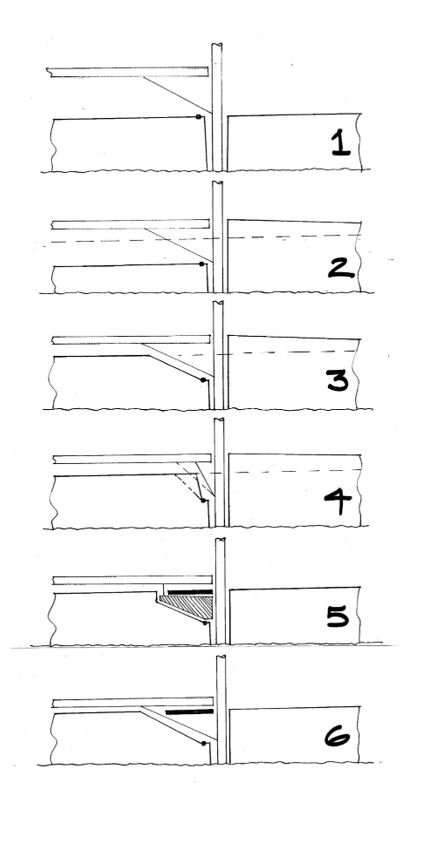
Questions are related to the diagrams and explanations shown below.
Item 4
Question: Is it reasonable that the mast deck limit mark can be placed at some distance down the mast trunking? Is this arrangement permitted?
Answer: Yes. Deck limit mark of minimum 5 mm in diameter shall be positioned on the centre plan of the hull near the mast position as defined in the IOM Class Rule D.1.5. Deck limit mark should be visible and should be possible to take measurement from that point (centre of deck limit mark).
Item 5
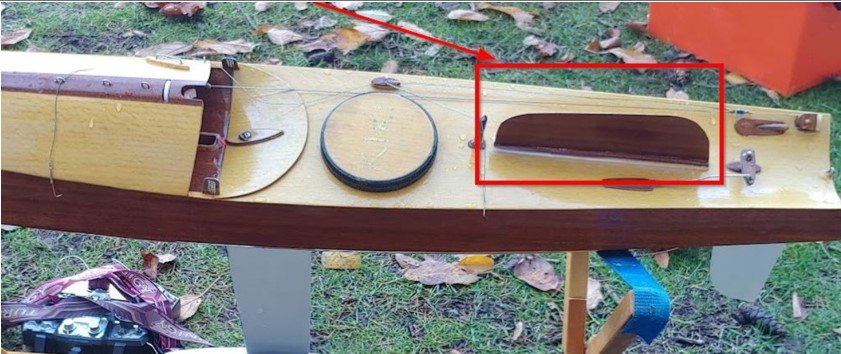
Question: Whereas there have been aft extensions of the foredeck past the mast position (and these are acknowledged as permitted by the Q&A), does the same logic apply to a plate that more fully closes the well?
Is it correct to accept that the mast deck limit mark is placed underneath the plate that more fully closes the well?
Answer: Deck limit mark may be placed on the deck underneath the kicking strap/gooseneck mast fitting regardless of the type/execution of the kicking strap/gooseneck mast fitting.
Item 6
Question: Whereas there have been aft extensions of the foredeck past the mast position (and these are acknowledged as permitted by the Q&A), does the same logic apply to a plate that more fully closes the well?
The mast kicking strap fitting in this case is normal. CR F2.4 (d) is complied with.
Is it permitted to place the mast deck limit mark underneath the plate that more fully closes the well?
Answer: Yes
Diagrams of centre plane cross sections in region of mast – brief descriptions
In all diagrams the mast deck limit mark is located where indicated by the dot.
In all cases the kicking strap itself is a conventional thin wire or line.
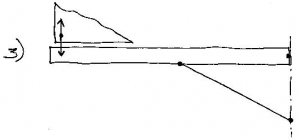
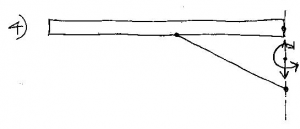
1 The typical arrangement in the early days of the class. A flat deck, mast trunking, mast deck limit mark on the flat deck adjacent to the mast.
2 The arrangement developed by Craig Smith around the mid1990s where the foredeck is raised and a ‘cockpit’ is formed aft of the partial bulkhead just ahead of the mast. The mast deck limit mark is on the floor of the cockpit adjacent to the mast.
3 The arrangement that evolved in the late 1990s where the foredeck is raised and a ‘well’ is formed around the mast. The mast deck limit mark is on the floor of the well adjacent to the mast.
4 As arrangement 3 but where the size of the well is progressively reduced to a minimal size. The mast deck limit mark is on the floor of the well adjacent to the mast.
5 As arrangement 3 but where the well is partially closed in by a plate (shown in solid) attached to and flush with the surrounding deck. The kicking strap attachment on the mast is a triangular plate in excess of 20 mm in vertical and horizontal dimensions (shown hatched). The kicking strap is near vertical connecting the main boom to the mast kicking strap attachment. The mast deck limit mark is on the floor of the well adjacent to the mast.
6 As arrangement 3 but where the well is partially closed in by a plate (shown in solid) attached to and flush with the surrounding deck. The kicking strap is normal. The mast deck limit mark is on the floor of the well adjacent to the mast.
29 January 2025
Exposed mast kicking strap fitting and/or gooseneck.
Received from designer Graham Bantock.
Question:
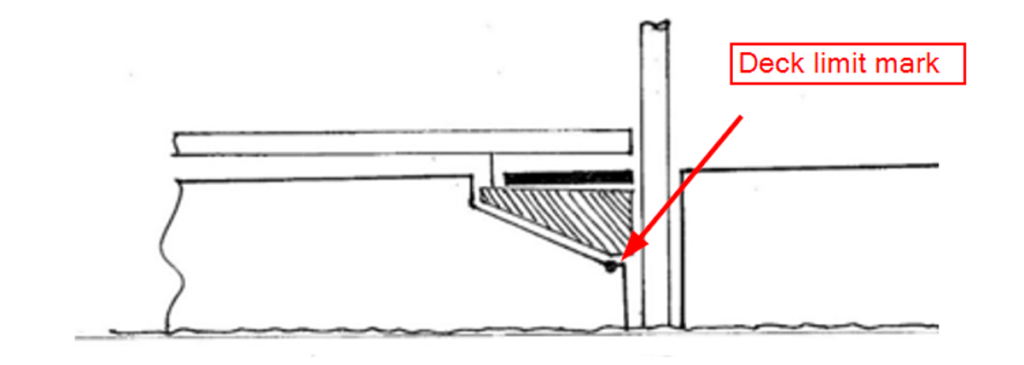
Is the mast kicking strap fitting and/or gooseneck on following sketch “exposed” according to the IOM Class Rule F2.4 (d) (1)
Answer:
Deck limit mark is positioned on the deck as shown on the sketch. It is below the mast kicking strap fitting and according to the IOM Class Rule F.2.4(d)(1) it is taken as “exposed” so the fitting shall not exceed 20 mm in any cross section perpendicular to the axis of rotation.
29 January 2025
Q&A – foredeck fitting
Received from Japan NCA
Question:
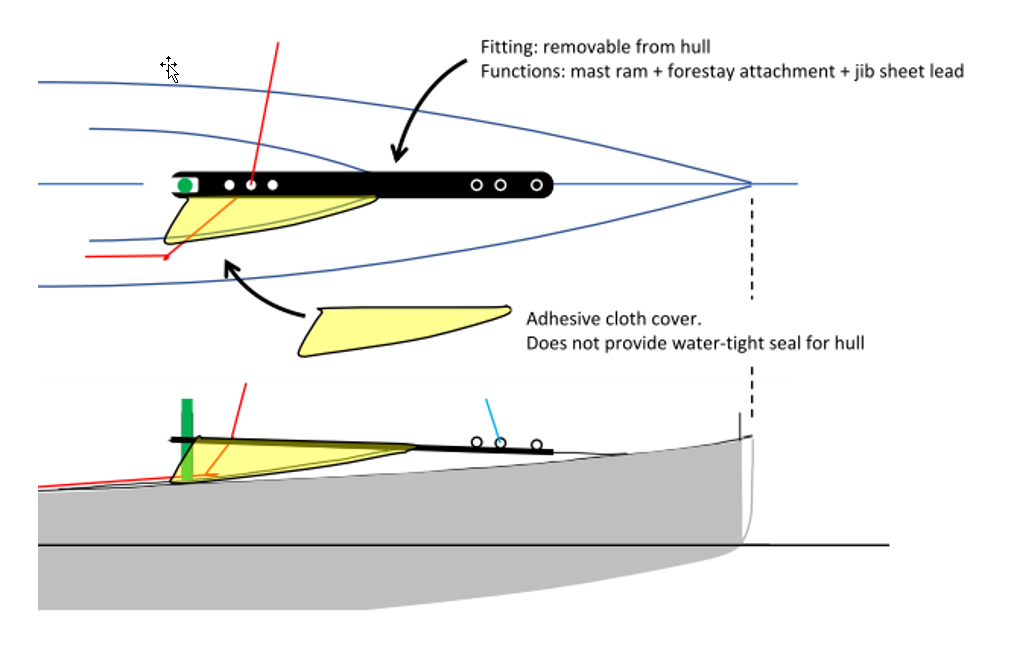
Are movable deck fitting and adhesive cloth as shown on sketches below allowed in accordance with the IOM Class Rules?
Relevant IOM Class Rules
Answer:
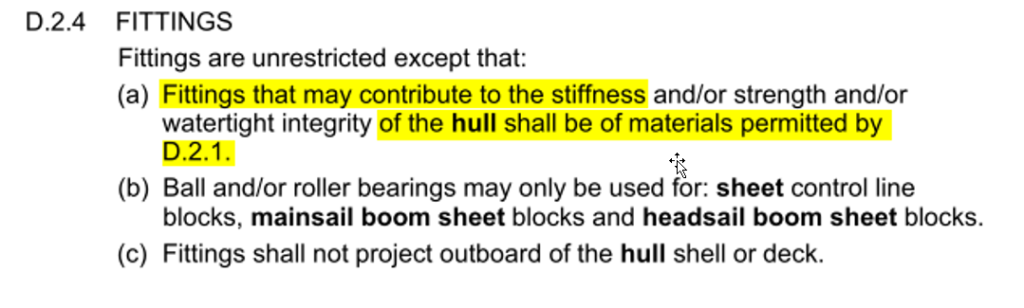
Item presented in the question is permitted. It is considered as hull fitting contributing to the stiffness and/or strength of the hull and therefore shall be of materials permitted by class rule D.2.1.
Adhesive cloth cover is permitted.
Is an interpretation and consequent Class Rule change needed?
No.
6 February 2025
Q&A – hollow bumper
Received from Japan NCA
Question:
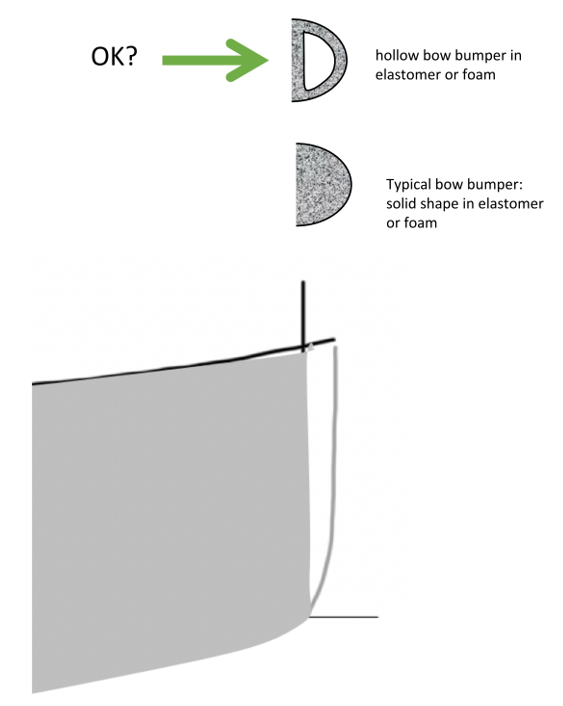
Is it permitted to have hollow elastic material of the bow bumper?
Relevant IOM Class Rules
Answer:
“Elastomeric foams” currently in use have some sort of voids or closed cells and it is difficult to say which size of hollow is allowed.
In general, when an certification measurer is of the opinion that a hull contains materials that do not comply with this class rule, he should note it on the measurement form. The Certification Authority should not issue a certificate but should ask for a sample of the material.
As an example, certification measurer should not accept a hull with forward 10 mm made of hollow elastomer with so thin surface which may be easily destructed in impact and not serving the purpose of the bow bumper.
There is no defined properties of the elastomer mentioned in the class rule D.2.2(c ). It is permitted to use hollow elastomer for forward 10 mm of the hull assuming it is capable of serving the purpose of the bow bumper.
Is an interpretation and consequent Class Rule change needed?
No.
21 February 2025
Received from designer & builder Zvonko Jelačić.
Questions:
I am seeking clarification regarding the legality of adding a drainage system for the mast well on an IOM hull. Please refer to the attached diagram illustrating several possible solutions. Could you please advise which of the following options are permitted under the current IOM Class Rules?
(a) Directly down through the bottom of the hull (below the waterline).
(b) Through the hull side above the waterline (instead of below).
I kindly request your guidance on whether these drainage solutions comply with the Class Rules.

Thank you very much for your time and clarification.
Zvonko Jelacic
Received from designer & builder Ernst Rohner.
Questions:
[…] I have questions concerning the topic “draining the mast/cockpit well by the keel box or by the keel sides”. Thank you very much for your clarifications and rule guidance.
Please find below a couple of pictures that exhibit the situation and the 3 design approaches.
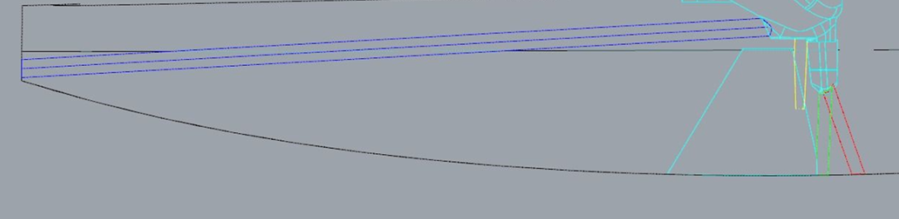
[Question 3A] Approach 1: Semi-circular draining channels on both sides of the keel box only, with semi-circular channels being part of the keel trunking in the hull.
[Question 3B] Approach 2: Semi-circular draining channels on both sides of the keel head only, without semi-circular channels being part of the keel trunking in the hull. The keel trunking in the hull follows the smooth shape of the keel profile.
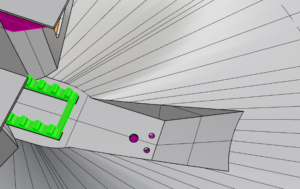
[Question 4] Are 2 additional holes in the mast/cockpit well IOM class rule compliant?
Which of these approaches are IOM class rule compliant, if any?
Picture 1 [Question 3A]:
Keel box with draining channels and keel trunking including draining channels.
Picture 2: [Question 3B]
Keel head with draining channels
Picture 3 [Question 4]:
Two openings/ holes in mast well
Answer:
Relevant IOM class rules
Introduction
The class rules for the International One Metre Class are closed class rules in which anything not specifically permitted by the class rules is prohibited. Individual rules may require, limit, or permit as necessary.
D.2.2 CONSTRUCTION
Construction is unrestricted subject for the following:
(b) Except for trunking for the keel and rudder, the hull shall not have:
(1) Voids in the waterplane and/or the underwater profile.
E.3.2 [KEEL AND RUDDER] CONSTRUCTION
Construction is unrestricted subject to the following:
(3) have openings through which water could flow when in use.
Relevant Terminology:
A void in the context of the hull’s waterplane or underwater profile refers to a closed shape that is inside the closed shape defined by the waterplane or underwater profile – i.e. it is a hole in the 2D surface defined by either the waterplane or the underwater profile.
A hollow in either the hull’s underwater profile or plan view is a concavity in a line that defines those views.
Trunking is not a defined term in the RRS, ERS, or IOM Class Rules. In this context, its meaning is broadly an enclosure or casing in the hull for the rudder or keel.
Answers to questions:
[Question 1A] Red: Connect a drainpipe from the mast well:
(a) Directly down through the bottom of the hull (below the waterline).
Answer: Not permitted due to the void in the waterplane caused by the drainpipe (IOM Class Rule D.2.2(b)(1))
(b) Through the hull side above the waterline (instead of below).
Answer: Permitted.
[Question 1B] Green: Connect the mast well drain to the fin trunk, enlarging the existing hole for the fin box to allow water to pass through.
Answer: Permitted
[Question 1C] Yellow: Connect the mast well drain to the fin trunk without modifying the fin hole, relying on a slight gap between the fin and fin box for water to exit.
Answer: Permitted. This relies on the exit of the drain being above the waterplane otherwise it will be a void in the waterplane and, therefore,not permitted.
[Question 1D] Blue: Route the mast well drain aft to the transom, exiting at the stern.
Answer: Permitted provided the exit point is above the waterplane. If the exit is below the waterplane, a void in waterplane is created and, therefore, it is not permitted.
[Question 2] Relying on a slight gap (how large a gap would still be considered acceptable) between the fin bolt and the fin box, and between the fin and the fin box, for water to exit.
Answer: Permitted.
[Question 3A] Draining channels on either side of the fin box/trunking.
Answer: Permitted – there is no restriction on the shape of the trunking for the keel.
[Question 3B]. Draining channels in the head of the keel fin.
Answer: Permitted. Although the channels in the keel fin are “openings”, provided they are completely contained within the trunking, water cannot flow through them. As a result, Rule E.3.2(b)(3) is not triggered.
[Question 4]. Holes in the bottom of the mast well leading directly to the keel trunking.
Answer: Permitted (same as Question 1C).
Is an interpretation and consequent Class Rule change needed?
No.
IOM ICA Technical Subcommittee
Andrew Crocker, VC Technical
Robert Grubiša, member
David Jensen, member
Updated February 2026
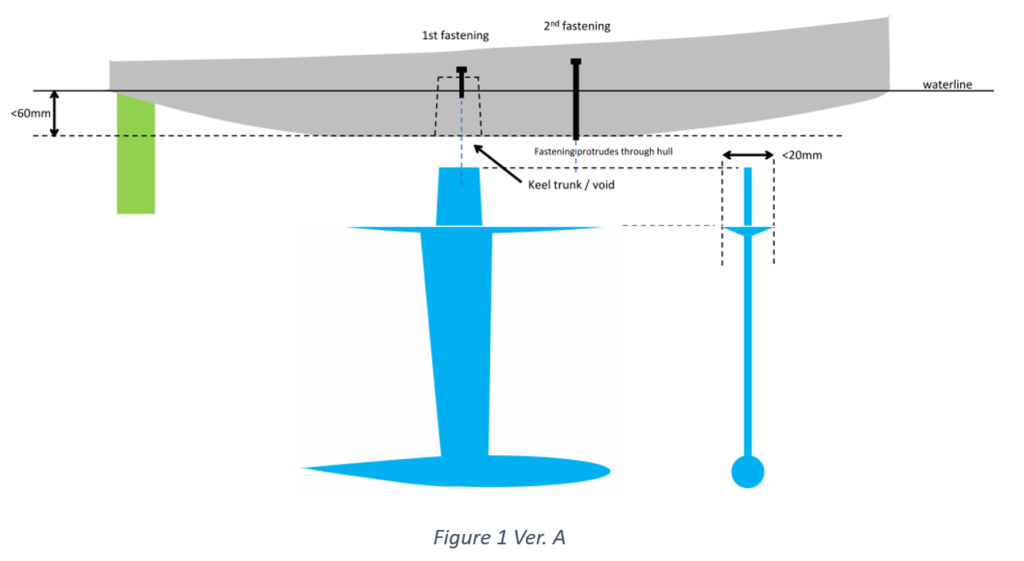
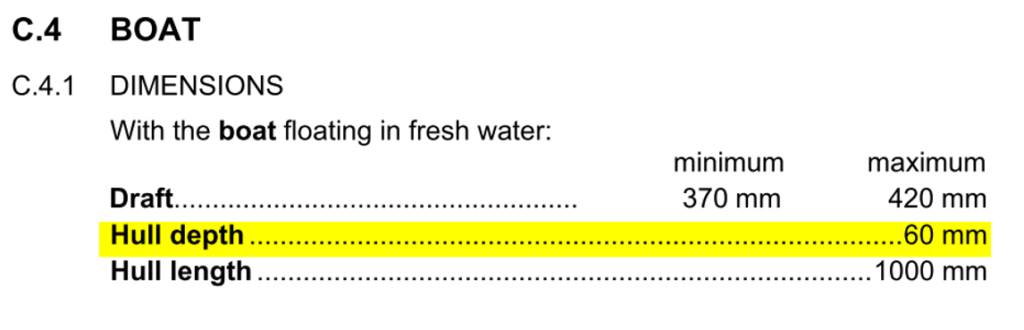
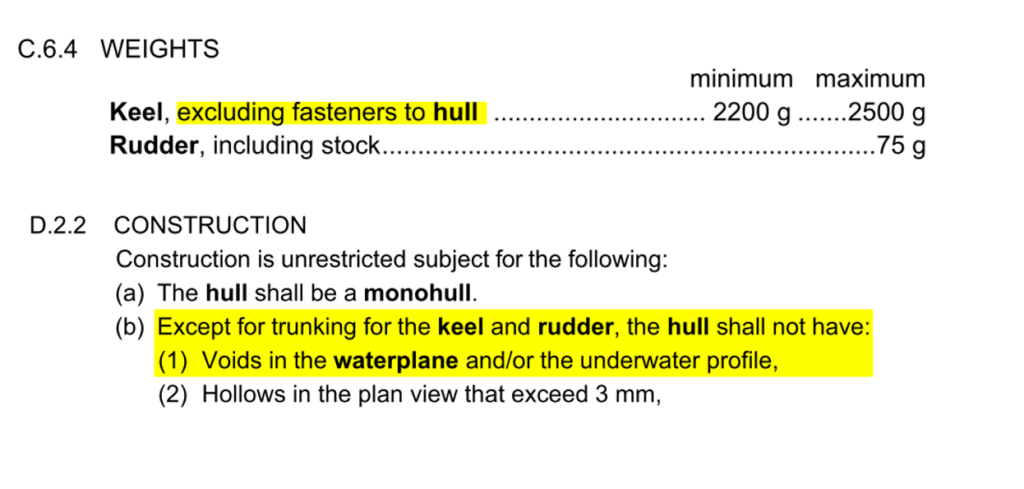
A – Second fastening would protrude through hole in hull.
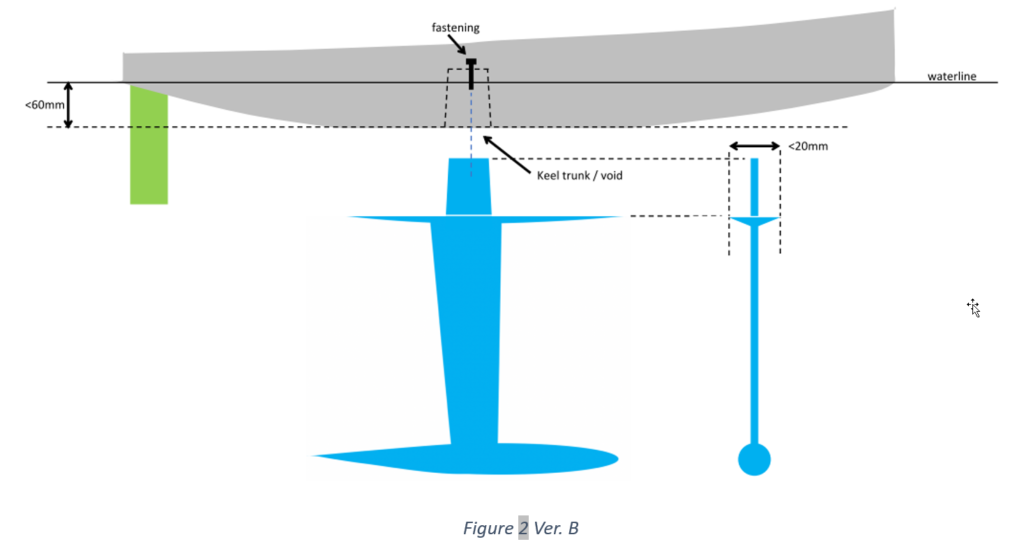
B – Single fastening only
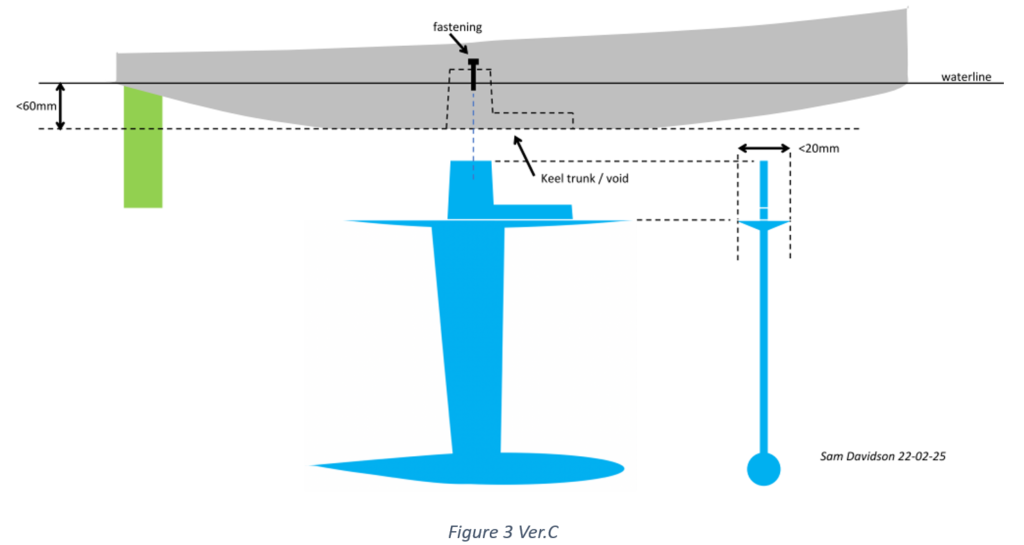
C – Variation on trunk. Single void for keel trunk
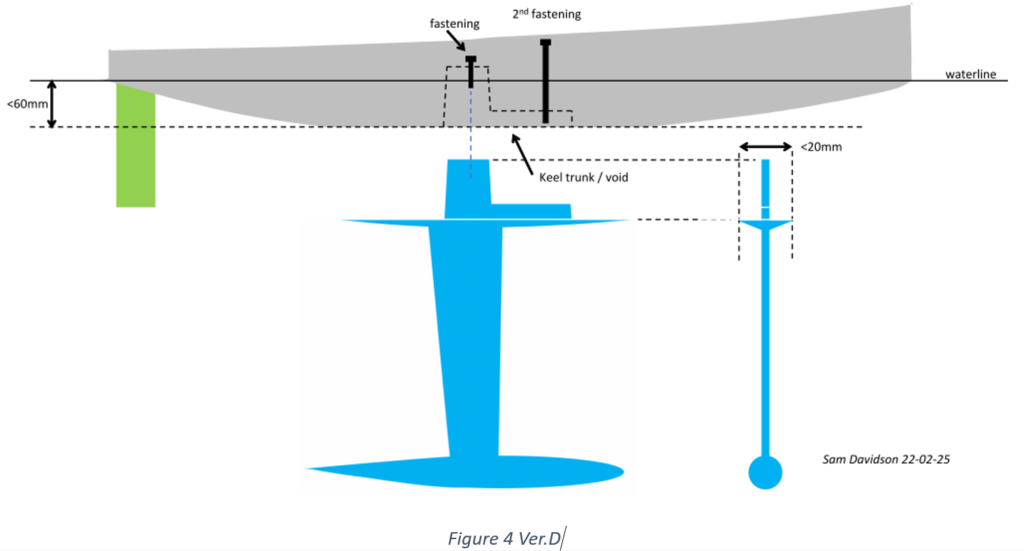
D – Same as C with 2nd fastener
Relevant IOM Class Rules:
Answers:
Ver. A: Not permitted because the 2nd fastening (as a part of the hull) extends more than 60 mm below the waterline (IOM Class Rule C.4.1)
Ver. B: OK
Ver. C: OK
Ver. D: OK
Is an interpretation and consequent Class Rule change needed?
No.
Relevant Rules:
Except where used in headings, when a term is printed in “bold” the definition in the ERS applies …”
MANDATORY [Hull Appendages]
(a) Keel which may comprise a fin and a bulb
(b) Rudder
“… movable hull appendage primarily used to affect steerage”
Class rules where anything not specifically permitted by the class rules is prohibited.
“.. hull appendage primarily used to affect leeway and/or produce vertical lift, which may incorporate any or all of the following:
Fuselage
Foil Mast
Elevator
Front Wing
Rear Wing”
“Any item of equipment – including the items listed in E.1.2 – which is:
Answers:
February 2026
Question details:
RMG Sailwinch has commenced production of a „belt drive sheet control line/unit” consisting of drum winch and sheet control line which runs along the deck (or below deck) and runs between the winch and any return pulleys. Is this belt drive unit permitted to be used on an IOM class boat?
Reference to the old interpretation issued before year 2017
Interpretation 2004-IOM-5 on IOM Class Rules – edition 2003
Answers:
IOM class rule C.7.6(a) concerns running rigging and indicates that the mainsail and the headsail sheets may be worked by a sheet control line attached to the sheet control unit.
IOM Class Rule F.6.1 indicates that materials of running rigging are unrestricted.
„Belt drive sheet control line/unit” as described by RMG Sailwinch is a type of sheet control line and it is permitted to be used on an IOM class boat.
Reference to the old interpretation issued before year 2017
Interpretation 2003-IOM-1 on the IOM CR – edition 2002
Answer:
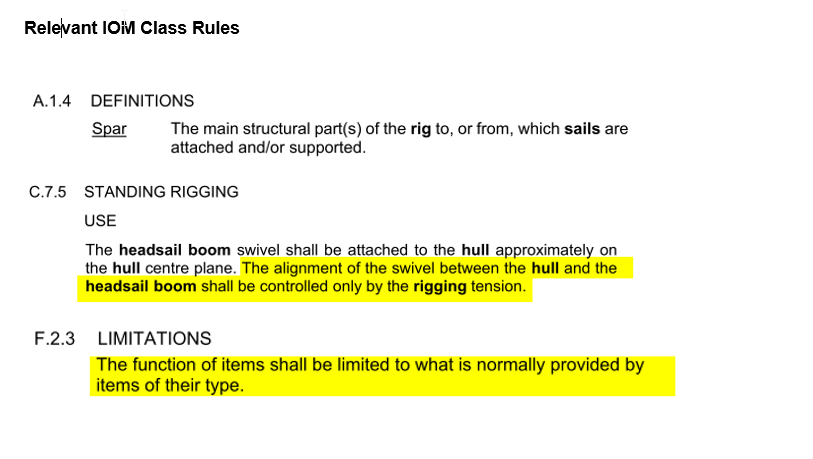
The IOM Class Rule (edition 2017) C.7.5 has requirements regarding the attachment point and alignment control of the swivel.
The deck is not a term defined in the Equipment Rule of Sailing. The ERS definition of the hull includes the deck among the other parts. It is not the purpose of rule C.7.5 to control the deck shape which may be a complex shape in either fore and aft or transverse directions especially in unmanned radio controlled boats. Thus the swivel may be attached to a point on the surface of the deck which may be lower or higher than the surrounding deck surface. Such a deck arrangement in the region of the swivel attachment point may include a recess in the deck, inverse camber, a tube or other complex shapes.
The fact that cord may touch the tube and thus change the direction of the cord is not against the requirement that the alignment of the swivel shall be controlled only by the rigging tension. The geometry of the deck or the attachment point may affect the alignment but this does not mean “controlling” as stated in class rule C.7.5.
As a result of above, a headsail swivel attached at any height inside a tube which is connected to the deck approximately on the hull centreplane is in compliance with class rule C.7.5.
Reference to the old interpretation issued before year 2017
Interpretation 2004-IOM-3 on IOM Class Rules – edition 2003
Answers:
IOM class rule F.3.3(b)(6) states that the mast spar ring and/or loop are optional fittings used to attach mainsail luff to the spar. Loop means a piece of non rigid material passed around the mast and carrying out the same function as a ring. These two items must be able to move freely. Class Rule F.3.3(b)(7) states that the mainsail jackstay fittings are optional mast fittings.
U-shaped nails driven into a mast to attach mainsail luff to the spar are not optional fittings as described by closed IOM Class Rules. U-shaped nails or staples are permitted if they are used to attach a jackstay.
Reference to the old interpretation issued before year 2017
Interpretation 2004-IOM-1 on the IOM CR – edition 2003
Answer:
The mast spar jackstay is defined as standing rigging by IOM class rule F.5.2(b)(3). Length and tension of rigging may be adjustable unless otherwise restricted as stated in IOM class rule F.2.4(b). The function of items shall be limited to what is normally provided by items of their type as stated in IOM class rule F.2.3. The normal function of the jackstay is to fasten mainsail to the mast and jackstay must be engineered accordingly.
The mast jackstay needs to be tensioned/adjusted in order to fasten mainsail to and this tension may contribute to bending/straightening the mast.
Questions details:
Which of the following rig arrangements are permitted?
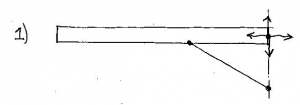
Case 1:The kicking strap is not adjustable and is fixed at each end. The forward end of the main boom is moved (up & down or fore & aft) using a fitting that is:
a) combined with the gooseneck fitting or
b)in addition to the gooseneck fitting

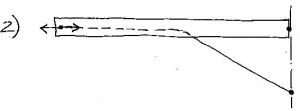
Case 2: The kicking strap passes through the boom and is adjusted in a fore & aft direction at the aft end of the main boom by using a fitting that is:b) in addition to the gooseneck fitting.
a) combined with the clew fitting or
b) in addition to the clew

Case 3: The kicking strap is not adjustable and is fixed at each end. The forward end of the boom is not adjustable on the gooseneck in any direction except for rotation. The clew of the mainsail is adjustable vertically by using a line that is:

Case 4: The kicking strap is not adjustable and is fixed at each end. The forward end of the boom is not adjustable on the gooseneck in any direction except for rotation. The rotational axis of the gooseneck is adjustable by:

Case 5: As case 1 except that the kicking strap is adjustable.
Case 6: As case 3 except that the kicking strap is adjustable.
Case 7: As case 4 except that the kicking strap is adjustable.
Reference to the old interpretation issued before year 2017
Interpretation 2012- IOM-1 on the IOM CR – edition 2011
Answers:
In all answers it is assumed that kicking strap, as part of running rigging, is capable to work in tension only.
Case 1(a)
The IOM Class Rules do not specifically permit a special fitting to adjust the forward end of the boom up and down, or fore and aft. This arrangement is therefore prohibited. IOM Class Rule F.2.4(b) however permits the gooseneck to be adjusted and there are no restrictions as to the directions.
Case 1(b)
The IOM Class Rules do not specifically permit such an „additional fitting”. This arrangement is therefore prohibited.
Case 2(a)
IOM Class Rule F.4.3(a)(3) requires a kicking strap fitting, IOM Class Rule F.4.3(a)(1) requires mainsail clew fitting(s) and IOM Class Rule F.2.4(a) allows fittings to be combined. This arrangement is therefore permitted.
Case 2(b)
IOM Class Rule F.4.3(a)(3) requires a kicking strap fitting. This arrangement is therefore permitted.
Case 3(a)
IOM Class Rule F.4.3(a)(1) require mainsail clew fitting(s), IOM Class Rule F.6.2(b)(2) permits a mainsail clew line and IOM Class Rule F.2.4(a) permits fittings and control lines to be combined. This arrangement is therefore permitted.
Case 3(b)
IOM Class Rule F.4.3(a)(1) require mainsail clew fitting(s) and IOM Class Rule F.6.2(b)(2) permits a mainsail clew line. This arrangement is therefore permitted.
Case 4(a)
IOM Class Rule F.2.4(b) permits fittings to be adjusted and there are no restrictions as to the directions. This arrangement is therefore permitted.
Case 4(b)
IOM Class Rule F.2.4(b) permits fittings to be adjusted and there are no restrictions as to the directions. This arrangement is therefore permitted.
Case 5
IOM Class Rule F.2.4(b) permits an adjustable kicking strap. The Case 1 interpretations apply to the „additional fitting”.
Case 6
IOM Class Rule F.2.4(b) permits an adjustable kicking strap. The Case 3 interpretations apply to the boom fitting(s) and the line.
Case 7
IOM Class Rule F.2.4(b) permits an adjustable kicking strap.
Questions details:
Are devices in following examples permitted?
Question 1
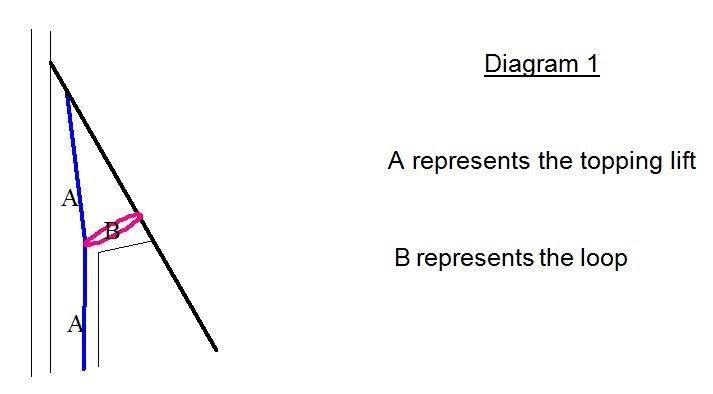
A device of type 1 is shown in Diagram1 being a loop which may be attached to the topping lift and/or the headsail stay.
Alternatively it may be a loop formed in the topping lift itself when the latter is made from cord, when it may be considered part of the topping lift.

Question 2
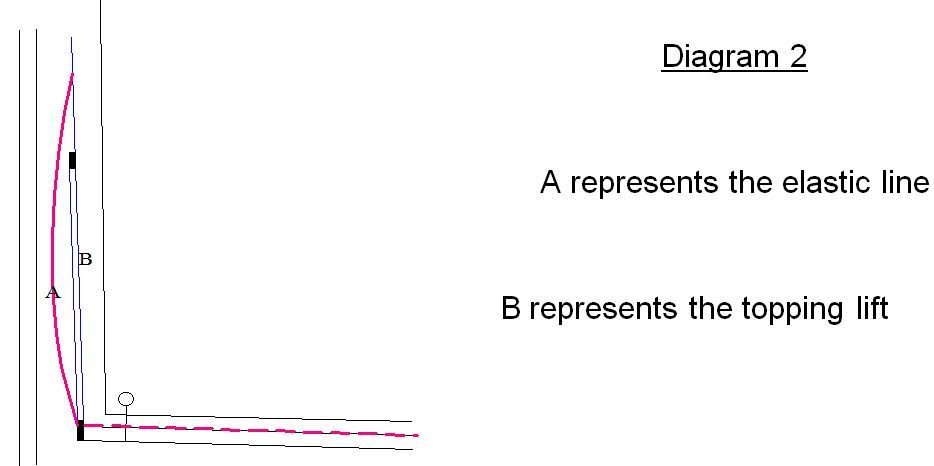
Diagram 2 shows an elastic line of type 2 which tensions the topping lift when the boom rises in a gust.
At one end it is attached to the topping lift and at the other is attached to the boom or a fitting on the boom.
A variation has it attached to the topping lift, passing through an eye on the end of the boom then passing forward to be attached to the boom as shown by the dotted line.

Question 3
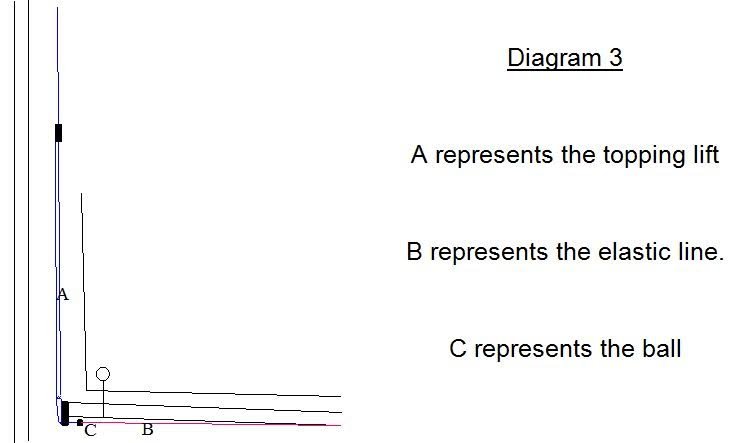
Diagram 3 shows a basic topping lift extended by a loop of cord which passes through an eye on the end of the boom and a further extension by an elastic line which is attached to the boom.
A ball on the end of the loop permits the topping lift to raise the boom as required, while the elastic line pulls the loop through the eye to take up the slack in a gust.

Question 4
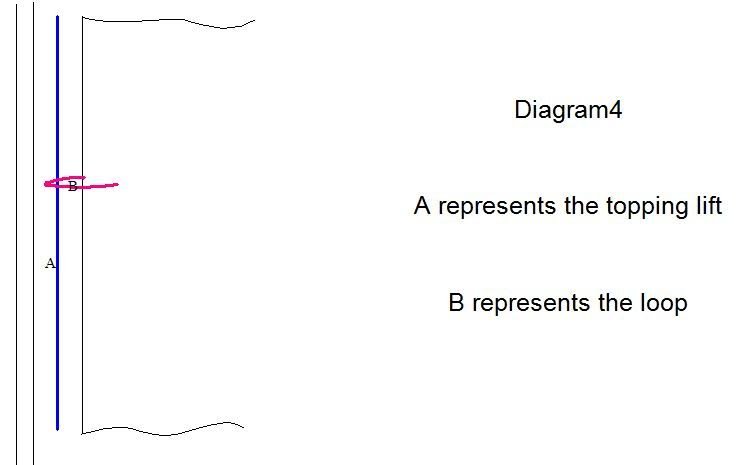
Diagram 4 shows a loop attached to the headsail and passing around the topping lift.
A variation has the loop passing around the headsail and attached to the topping lift.
Both are of type 2

Question 5
Is it permitted to have any combination of two or more of the various types of line shown in diagrams 1 to 4 ?
Reference to the old interpretation issued before year 2017
Emergency IOM Class Rule changes made after Interpretation 2014-IOM-3 on IOM Class Rules 2013 has been published
Answers:
All presented devices/arrangements are permitted by the IOM Class Rules F6.2(b)(8) which permit use of one or more headsail boom topping lift restraint lines. IOM Class Rule C.7.6(c) describe the way of attachment and passing around other parts of rig and headsail.
Question:
Is the size of the rotating part of the mainsail halyard fitting listed in the IOM Class rule F.3.3(c)(1) limited in any way?
Question details:
Is the size of the rotating part of the mainsail halyard fitting listed in the IOM Class rule F.3.3(c)(1) limited in any way?
Reference to the old interpretation issued before year 2017
Interpretation 2003-IOM-4 on the IOM CR – edition 2002
Answer:
IOM class rules F.2.3 and F.2.4 (a) restricts the size of the fittings.
Question details:
Is it permitted to fit a boat with more than one ‘sheet control line’?
With the use of lever arm winches, the question has been raised about the use of two sheet control lines. These are two lines, one from each end of the arm, each with its own control elastic, to which the mainsail sheet and headsail sheet are attached.
Is it permitted to work the mainsail sheet and headsail sheet with more than one sheet control line?
Reference to the old interpretation issued before year 2017
Interpretation 2003-IOM-3 on the IOM CR – edition 2002
Interpretation 2003-IOM-4 on the IOM CR – edition 2002
Answer:
In the IOM class rules C.7.6(a) and F.6.2(b)(9) the term „sheet control line” is used in the singular so only one sheet control line may be used. It is important to make a distinction between sheet control line, mainsail sheet and headsail sheet.
Sheet control line is optional part of the running rigging and it is permitted to attach the mainsail sheet and headsail sheet directly to the lever arm winch without the sheet control line.
Questions details:
Question A:
Is it permitted to have a fitting in the form of a ring which goes closely round the mast and both shrouds and which may be adjusted vertically between the shroud attachment fitting and the spreaders (if used)?
Question B:
Is it permitted to have a fitting in the form of a ring which goes closely round the mast and both shrouds and which is fixed at some point between the shroud attachment fitting and the spreaders (if used)?
Question C:
If neither A nor B is permitted, is it permitted to use alternative shroud attachment points during an event?
Question D:
If shroud fittings are used, is it permitted to have openings for shrouds also (and vice versa)?
Reference to the old interpretation issued before year 2017
Interpretation 2011- IOM-2 on the IOM CR – editions 2009
Answers:
Answer to question A:
It is permitted to have a fitting in the form of a ring which goes closely round the mast and both shrouds and which may be adjusted vertically between the shroud attachment fitting and the spreaders (if used). Such ring would be considered as one of shroud fittings permitted in IOM class rule F.3.3(a)(2). Adjustment is permitted in accordance with IOM class rule F.2.4(b).
Answer to question B:
It is permitted to have a fitting in the form of a ring which goes closely round the mast and both shrouds and which is fixed at some point between the shroud attachment fitting and the spreaders (if used). Such ring would be considered as one of shroud fittings permitted by IOM class rule F.3.3(a)(2).
Answer to question C:
It is permitted to use alternative shroud attachment points during an event. IOM CR F.3.3(a)(2) allows the use of shroud openings and IOM CR F.2.4(b) permits adjustments to position of parts.
Answer to question D:
If shroud fittings are used, it is permitted to have openings for shrouds also (and vice versa). Shroud fittings and opening are permitted by IOM CR F.3.3(a)(2).
Question details:
A strut normally works in compression so is one that acts in tension compliant with IOM class rule F3.3(b)(9)?
Reference to the old interpretation issued before year 2017
Interpretation 2003-IOM-4 on the IOM CR – edition 2002
Answer:
A mast strut listed in the IOM class rule F.3.3(b)(9) is not part of rigging. It is fitting so it is allowed to work in compression as well as in tension.
Question details:
Reference to the old interpretation issued before year 2017
Interpretation 2004-IOM-2 on the IOM CR – edition 2003
Answers:
Question details:
The ERS 2017-2020 F.1.6 defines rigging as “Any equipment attached at one or both ends to spars, sails or other rigging and capable of working in tension only. Includes associated fittings which are not permanently fixed to a hull, spar or spreader.” Where rigging is bent round a terminating hook and then round itself, this rigging is clearly not acting in tension only. Is it permitted to use stainless steel rigging as stated in the IOM class rule F.5.1 having in mind ERS defined term rigging?
Reference to the old interpretation issued before year 2017
Interpretation 2003-IOM-4 on the IOM CR – edition 2002
Answer:
Parts of rigging can work in compression and bending (which is part in tension and part in compression) as well as in shear and torsion. The ERS definition of rigging is referred to the whole piece of rigging i.e. (shroud, forestay, backstay) which shall be capable of working in tension only.
It is obvious that the whole length of a shroud, backstay or forestay is not capable of working in compression and this fact is important regarding the ERS definition. The fact that a particular short part of the rigging may work under compression also is irrelevant for this purpose.
Question details
Question 1:
(i) May the headsail and mainsail sheets be of different materials, and/or of mixed materials, and/or different sizes?
Answer: See above – YES/YES/YES.
(ii) If the answer to (1)(i) is “Yes”, may the mixed materials be connected using intermediate components, for example, small steel rings, fishing line snap hooks, or roach pole elastic connectors?
Answer: See above – YES. The definition of rigging includes fittings not fixed to a hull, spar or spreader.
Question 2 :
(i) May the sheet be terminated by an elastic component which is in turn fixed to the boom or to the boom fitting?
Answer: The sheet may incorporate an elastic element as material for a sheet is not controlled
(ii) May the sheet be terminated by a component which is itself terminated in turn and fixed to the boom or to the boom fitting? For example, where a Dyneema sheet is terminated by a length of silicone line, the silicone line may itself be terminated by a small steel ring, a fishing line snap hook, or a roach pole elastic connector.
Answer: The Dyneema sheet (jn this example) is not terminated by the length of silicone line. They are both elements of the sheet and may have a connector fitting (not fixed to a hull, spar or spreader) to make the connection. The end of the sheet (in this case the length of silicone line) may have a termination that connects to the boom’s sheet fitting.
Question 3: May the sheet attach to an element of the boom fixing or fitting which rotates?
Answer: The sheet may have a termination that connects to the boom’s sheet fitting. Provided it functions in a way that its function is not extended beyond that of a sheet attachment (F.4.3 a & b, F.4.4 a & b), then it is permitted.
The fitting described in the RFI does extend this function and is not permitted.
Question 4 : Where the sheet attaches to a boom fixing or fitting, may the boom fixing or fitting have an elastic component?
Answer : See above – Provided the boom’s sheet fitting functions in a way that its function is not extended beyond that of a sheet attachment, then it is permitted.
The fitting described in the RFI does extend this function and is not permitted.
Question 5 :
(i) May the sheet control line be of mixed materials?
Answer : Yes
(ii) If the answer to (5)(i) is “Yes”, may the mixed materials be connected using intermediate components, for example, small steel rings, fishing line snap hooks, or roach pole elastic connectors?
Answer : See above – YES. The definition of rigging includes fittings not fixed to a hull, spar or spreader.
Question 6 : May a sheet or the sheet control line have (i) stop knots and/or beads, and/or (ii) sheathes and/or sleeves, or similar components?
Answer : Each may have knots and other elements of a piece of rigging; fittings not fixed to a hull, spar or spreader are permitted. Provided sheathes and sleeves do not prevent the sheet from compliance with the requirements for a sheet in the IOM Class (see above) then they are permitted.
F.1.6 Rigging
Any equipment attached at one or both ends to spars, sails or other rigging and capable of working in tension only. Includes associated fittings which are not permanently fixed to a hull, spar or spreader.
F.1.7 (b)
(vi) SHEET
Rigging used to trim the clew of a sail, or a boom spar.
C.7.6 RUNNING RIGGING USE
(a) The mainsail sheet and the headsail sheet may be worked by a sheet control line attached to the sheet control unit.
F.2.3 LIMITATIONS
The function of items shall be limited to what is normally provided by items of their type.
F.2.4 CONSTRUCTION
(a) Fittings and/or control lines may be combined provided their function is not extended beyond what is permitted.
(b) The position of parts, and the length and tension of rigging, may be adjustable unless otherwise restricted.
F.4.3 MAINSAIL BOOM FITTINGS
(a) MANDATORY
(2) Mainsail boom sheet fitting(s).
(b) OPTIONAL
(3) Opening(s) for mainsail boom sheet fitting.
F.4.4 HEADSAIL BOOM FITTINGS
(a) MANDATORY
(2) Headsail boom sheet fitting(s).
(b) OPTIONAL
(4) Opening(s) for headsail boom sheet fitting.
F.6.2 PARTS
(a) MANDATORY
(1) Mainsail boom sheet.
(4) Headsail boom sheet.
(b) OPTIONAL
(9) A sheet control line.
F.6.3 FITTINGS
OPTIONAL
(a) Terminations.
(b) Length and tension adjustments.
Discussion
C.7.6 tells us that the sheet control line worked by the sheet control unit may work the mainsail sheet and headsail sheet.
F.6.2 (a) tells us that a mainsail boom sheet and a headsail boom sheet are permitted.
Conclude a single sheet is permitted for each boom.
Conclude a sheet control line is not an item of rigging.
A sheet is defined as an item of rigging.
Rigging is defined as:
Any equipment attached at one or both ends to spars, sails or other rigging and capable of working in tension only. Includes associated fittings which are not permanently fixed to a hull, spar or spreader.
F.6.1 tells us the materials used in rigging are unrestricted.
Conclude the sheet may vary in its construction (material and design) along its length.
F.6.3 (a) tells us that terminations (undefined) are permitted. Therefore the attachment at one or both ends is permitted and, because F.6.1 tells us materials used are unrestricted, their material is unrestricted.
Other optional fittings for running rigging are:
Length and tension adjustments
Blocks
Wind indicator
The definition of rigging tells us that fittings e.g. shackles, hooks, caribiners, clip hooks, balls, connections etc, not permanently fixed to a hull, spar or spreader, are permitted as part of the sheet.
Conclude connector fittings joining more than two or more parts of a sheet are permitted.
Conclusion
Answers to the questions asked are given in the sections above.
No interpretation is required as a result of the questions asked as the relevant ERS and Class Rules provide straightforward answers to the original questions.
Where no interpretation is necessary to answer questions posed it is not required to have the formal discussion with IRSA that is necessary for an interpretation.
Question details:
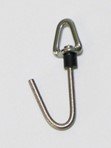
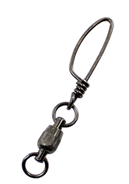
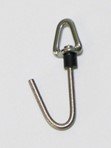
Is it permitted to have the forestay and headsail halyard both connected to the ring of a swivel hook made as shown in the graphic below?
Figure 1
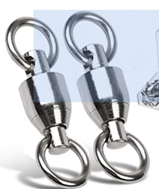
Is it permitted to have any types of standalone swivels (with or without ball bearings) in the forestay?
Figure 2 Figure 3 Figure 4
Answer:
Relevant IOM class rules
Relevant Equipment Rules of Sailing rules:
Discussion:
A termination is a way of attaching a piece rigging (standing or running, line or wire) to a spar (mast, boom) or the hull. Length and tension adjustments are specifically permitted by the class rules F.5.3 and F.6.3.
In addition, the position of parts may be adjustable by class rule F.2.4(b).
Rotation/swivelling is not specifically permitted for terminations.
It is allowed to have more than one part in terminations. Terms in F.5.3 and F.6.3 are plural. A few examples are:
Figures 3 and 4 are showing multi parts terminations but one of the parts is a fishing swivel so they are not allowed.
Answers:
Is an interpretation and consequent Class Rule change needed?
No.
Question details:
Having in mind answers given in the Q&A titled “Questions related to the various shroud attachment points on the mast” in which it is stated that:
– Shroud fittings and opening are permitted,
– It is permitted to use alternative shroud attachment points during an event,
– It is permitted to have a fitting in the form of a ring which goes closely round the mast and both shrouds and which may be adjusted vertically between the shroud attachment fitting and the spreaders (if used).
Please find the following question:
Fittings in the form of rings which goes round the mast are used:
– For headsail stay attachment to the mast,
– For attachment of the shrouds to the mast and
– For tensioning of shrouds between shrouds and spreaders (if used)
Positions of the above-mentioned fittings may be adjusted along the mast spar.
Is it permitted to have dents instead holes in the mast spar on fixing positions of above mentioned fittings?
Relevant IOM Class Rules:
F.3.4 Dimensions
Answer:
Dents which are outside of permitted mast spar section shape tolerances are not allowed, so it is not permitted to have purposely made dents instead holes in the mast spar on fixing positions of fittings in question. Possible dents caused by using screws to fix fittings on mast spar are allowed.
6.10.2023.
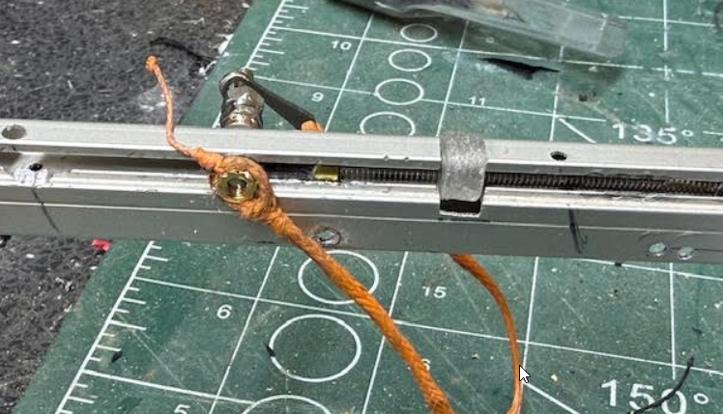
Control of the fixed length kicking strap tension screw in the main boom
Received from Colin Hatton – designer and builder via GBR NCA
Question:
Is controlling of the fixed length kicking strap tension using screw in the main boom, a knurled nut and a slug that connects via a rod to the kicking strap strop that attaches to both sides of the boom permitted?
Answer:
Arrangement shown on the photo is considered as a kicking strap fitting with adjustable position to allow the functioning of the fixed length kicking strap.
The fitting should be no bigger than needed for its purpose meaning that the screw/threaded rod in the main boom should be such to allow the movement of the nut for control of the mainsail leech and not to provide additional stiffness to the main boom.
The class rules do not provide for reinforcement of the boom spars in way of fittings.
Having in mind arrangement shown on the sketch and the above mentioned restriction, such kicking strap fitting is permitted.
4 February 2025
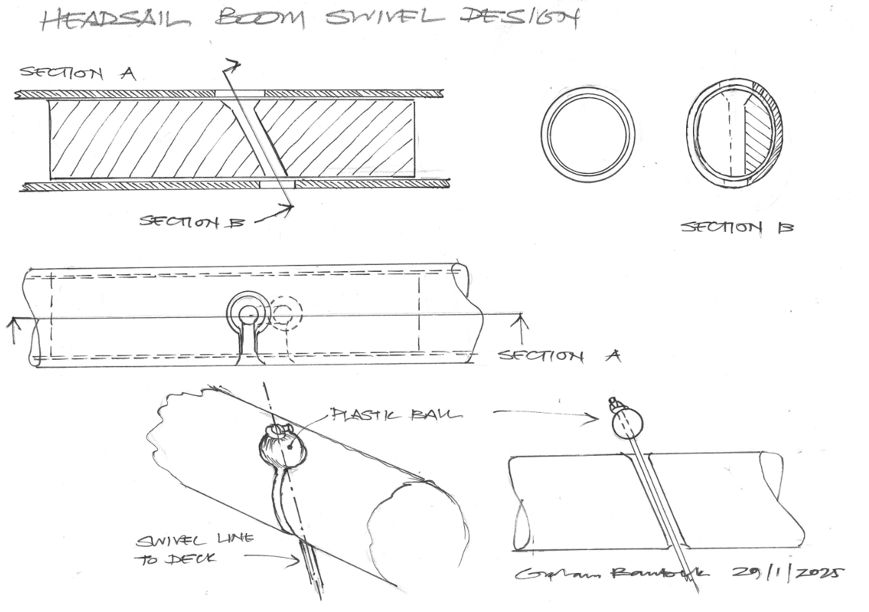
Q&A – headsail boom swivel fitting
Received from Graham Bantock – IOM designer and builder
Question:
Is headsail boom swivel fitting as shown in sketch in accordance with the IOM Class Rules?
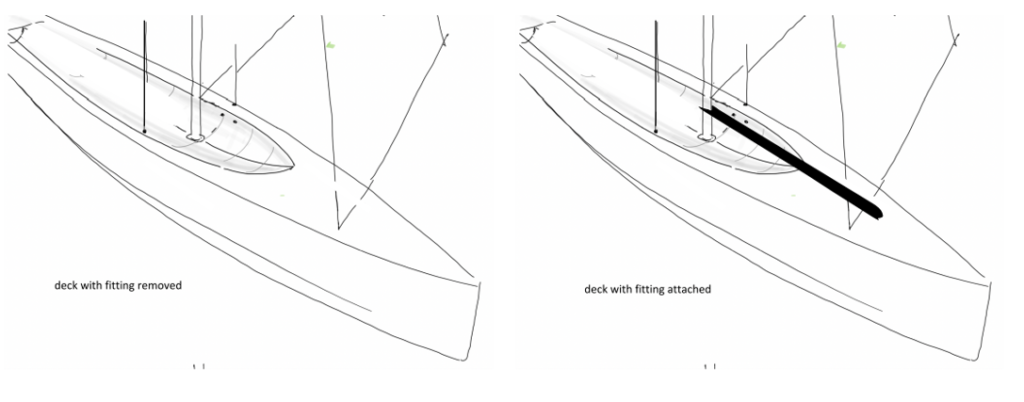
Answer:
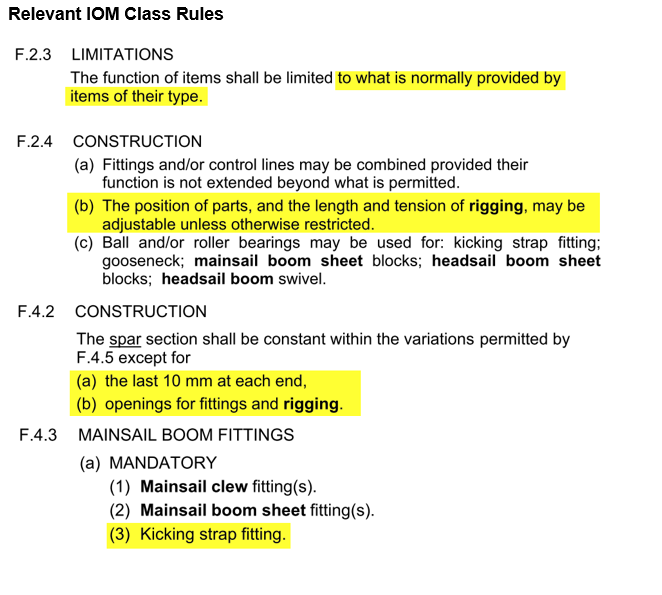
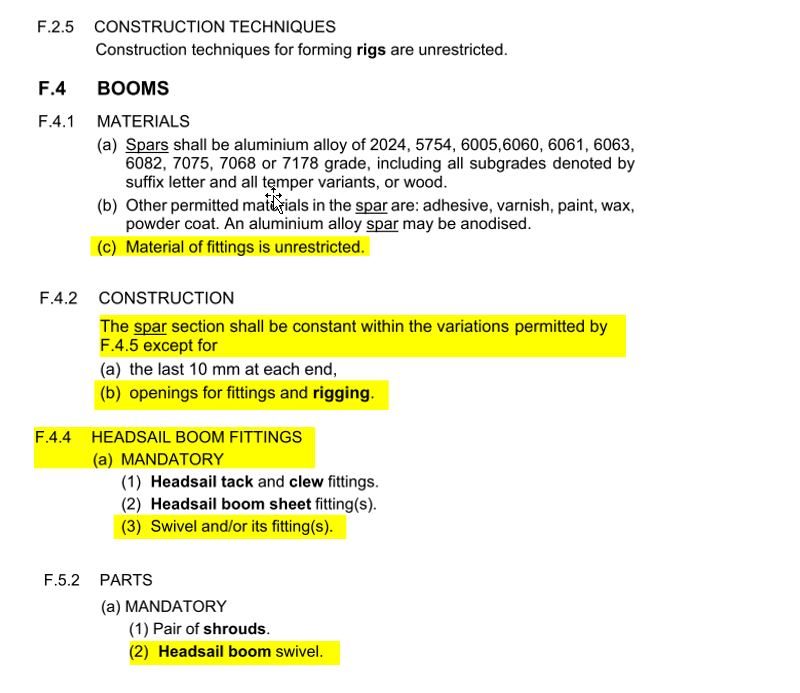
Boom spar may have openings for fitting and rigging. Class rules are not defining the size of such opening. Headsail boom mandatory items are swivel and/or its fittings.
The size of the fitting shall be limited to what is normally provided by items of their type.
This type of fitting is permitted.
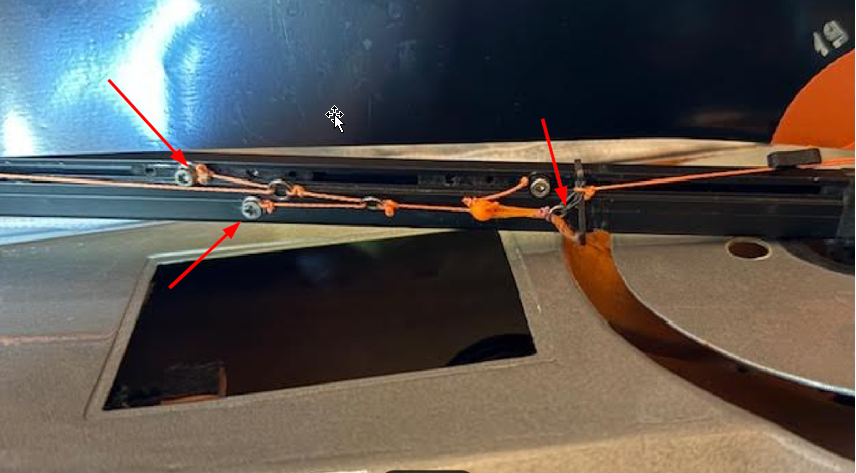
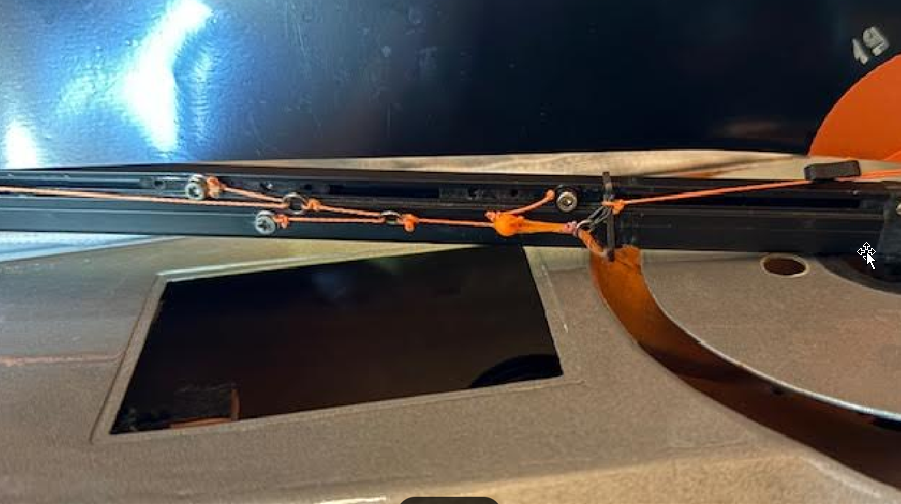
Control of the kicking strap tension using a main boom fitting(s)Received from Colin Hatton – designer and builder via GBR NCAQuestion:Is controlling of the fixed length kicking strap tension using set of lines and attachment points on a main boom as shown on photo below permitted?
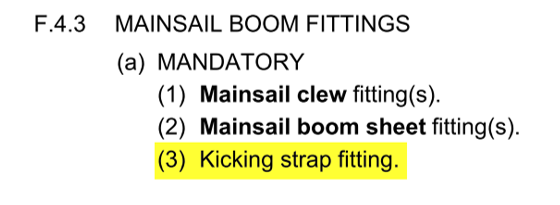
F.4.3 MAINSAIL BOOM FITTINGS
(a) MANDATORY
(3) Vang fitting(s).
(b) OPTIONAL
It is assumed that the lines shown on the photo are used to control tension of the fixed length kicking strap below the part of the deck. There are more than one kicking strap fitting, marked with red arrows:
Class Rule F.4.3. now permits multiple vang fittings on the boom, so the arrangement depicted above is permitted.
Is an interpretation and consequent Class Rule change needed?
No.
Revised: February 2026
First Issued: March 2025
Question:
Now that the undefined term “kicking strap” has been replaced with the Class Rules defined term “vang”, and given that a vang is defined as “[e]quipment connected to the boom and used to control the angle between the mast and the boom”, can a vang operate in compression as well as in tension in order to control that angle?
Relevant Class Rules
A.1.4 DEFINITIONS
Vang Equipment connected to the boom and used to control the angle between the mast and the boom.
F.6.2(a) [RUNNING RIGGING, PARTS] MANDATORY
(2) Mainsail boom vang
Relevant ERS Definitions
F.1.6 Rigging
Any equipment attached and/or connected at one or both ends to spars, sails or other rigging and capable of working in tension only. Includes associated fittings which are not permanently fixed to a hull, spar or spreader.
F.1.7 Rigging Types
(b) RUNNING RIGGING
(xi) VANG
Discussion
For the purposes of this discussion, “operating in tension” with respect to a vang means that it is pulling the boom down, toward the deck. “Operating in compression”, on the other hand, would mean pushing the boom up, away from the deck.
As an item of running rigging, a vang must comply with the ERS definition of rigging that includes the requirement that it be “… working in tension only …”. Simplistically, then, the answer to the question is that a vang must operate in tension only.
However, the wording of the ERS definition could be considered problematic for many vangs in common use on IOMs. Specifically, the ERS definition requires that a vang be “… capable of working in tension only [my emphasis]”. Most vangs in use begin to work in compression beyond a certain boom angle by virtue of their design. In other words, if the sail is disconnected from the boom, the vang will prevent the boom falling all the way to the deck at the point at which it begins to work in compression, and so they can be said to not be “… capable of working in tension only”.
The requirement to work in tension only therefore needs to be understood as referring to the vang in its normal operating position. When the vang is in its normal operating position, it must only act in tension (pulling the boom down) and must not be capable of operating in compression (pushing the boom up). Note that a vang or boom vang fitting that uses a spring as a part of its attachment mechanism may also cause the vang to act in compression.
Answer
Regardless of the change in terminology from “kicking strap” to “vang”, and the associated definition, a vang must only operate in tension in its normal operating position.
For measurers, this means ensuring that the following is the case:
• With the vang adjusted to its normal position (i.e. acting in tension on the boom to allow a limited twist in the mainsail), it should be possible to pull down on the boom to the point where the leech of the mainsail prevents it moving any further. Ensure that any springs that may be used in the vang assembly or boom vang fitting are not acting in compression at this point.
• When this point is reached, there should remain some downward “play” in the vang indicating that it is not acting in compression through the extent of its normal operational position.
February 2026
Question.
Do the IOM Class Rules limit the size of a vang?
Referenced Class Rules (as amended by Resolution 2025.2):
• [INTRODUCTION]
The class rules for the International One Metre Class are closed class rules in which anything not specifically permitted by the class rules is prohibited. Individual rules may require, limit, or permit as necessary.
• A.1.4 [DEFINITIONS]
Vang – Equipment connected to the boom and used to control the angle between the mast and the boom.
• F.2.3 [RIG, GENERAL] LIMITATIONS.
The function of items shall be limited to what is normally provided by items of their type.
• F.2.5 [RIG, GENERAL] CONSTRUCTION TECHNIQUES
Construction techniques for forming rigs are unrestricted.
• F.6.1 [RIG, RUNNING RIGGING] MATERIALS
Materials of running rigging are unrestricted.
• F.6.2 [RIG, RUNNING RIGGING] PARTS
(a) MANDATORY
(2) Mainsail boom vang.
F.1.6 [GENERAL RIG TERMS] Rigging
Any equipment attached and/or connected at one or both ends to spars, sails or other rigging and capable of working in tension only. Includes associated fittings which are not permanently fixed to a hull, spar or spreader.
F.1.7 [GENERAL RIG TERMS] Rigging Types
(b) RUNNING RIGGING
(xi) VANG
G.1.1 [GENERAL SAIL TERMS] Sail
An item of equipment, used to propel the boat.
Noting that the Class Rules may require, limit, or permit. With respect to a vang:
• A vang is a required item of running rigging under Class Rule F.6.2(a)(2).
• F.2.5 permits the construction techniques for items in the rig to be unrestricted.
• F.6.1 permits that the materials for running rigging are unrestricted.
• The only limiting rules relevant to a vang are Class Rule F.2.3 and the ERS definition of rigging.
Class Rule F.2.3 focuses only on function (“The function of items shall be limited to what is normally provided by items of their type”) and so has no immediate relevance to size. It has, however, been suggested that the surface area of a vang will generate a propulsive force and, therefore, provide a secondary function (that of a sail). It is equally the case that all rig items (other than sails) have some surface area and so all rig items generate some amount of propulsive force, yet it would be nonsensical to suggest that all rig items breach Class Rule F.2.3. As a result, Class Rule F.2.3 cannot be considered a limiting rule regarding the size of a vang as it provides no guidance on when the size of an item may constitute a secondary function.
The ERS definition of rigging (noting that a vang is a part of the running rigging) requires that is must only operate in tension. A vang, therefore, is limited to operating in tension. See “Question and Answer – Vang acting in compression” for further details. Again, this limit has no bearing on the size of a vang.
There is no limit on the size of a vang in the IOM Class Rules.
Date: February 2026
Question details:
Cringles are limited to four in total in the IOM class rules G.3.1(b)(2) & (3), but luff openings for mast spar rings and/or loops for mast spar jackstay fittings are not limited in the IOM class rule G.3.1(b)(4) . Is it permitted to use metal eyelets for some or all of these openings? Also is there a restriction on the location of any of these eyelets?
Reference to the old interpretation issued before the year 2017
Answer:
It is permitted to use metal eyelets to form luff fittings for mast spar rings and/or loops and/or for a mast spar jackstay. Their position is restricted to the luff as defined in the ERS.
Question details:
How shall a seam be checked for compliance with class rules G.3.1(a)3 or G.4.1(a)3?
Reference to the old interpretation issued before year 2017
Interpretation 2003-IOM-5 on the IOM CR – edition 2002
Answer:
IOM class rules G.3.2(a)(1) and G.4.2(a)(1) describes the seams which, if used, shall connect the luff and leech. The seam is defined in the ERS 2017-2020 G.1.4(h). If a straight line connects the edge of the seam where it intersects the luff with the same edge of the seam where it intersects the leech, the right angle distance between this line and any point along the relevant edge of the seam shall not exceed 10 mm. Cutouts in the part/parts of the body of the sail used to shape the sail are not seams and therefore this method is not a permitted construction technique.
Question details:
The sails shown in the photo were submitted for measurement.
The manufacturer of these sails considers that all the sail panels are of the same ply and the white panels are the same ply with pigment added.
An interpretation or explanation of G.3.1(a)(2) and G.4.1(a)(2) with respect to these sails is requested.
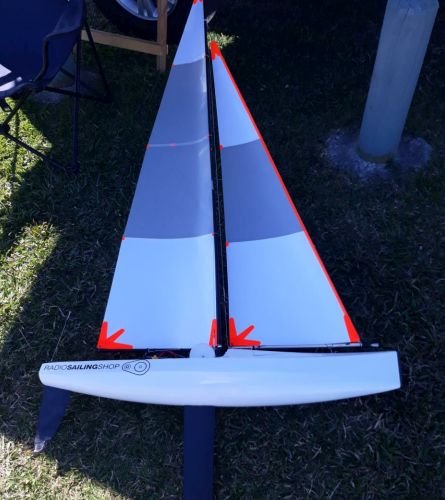
Answer:
According to the ERS G.1.4 (b) Ply is a sheet of sail material.
According to the IOM Class Rules G.3.1(a)(2) and G.4.1(a)(2) the body of the sail shall consist of the same ply throughout.
So, a same sheet of sail material must be used for the construction of an IOM sail. The sail material from the same roll/batch shall be used for a construction of a sail. Sails on photo attached to the request for interpretation/explanation are made of two different ply. Sail panels made of ply of different colours, weight, surface finish and pattern are not the „same ply” as requested by the IOM Class Rules G.3.1(a)(2) and G.4.1(a)(2) and therefore not permitted.
Answer:
IOM Class Rules G.3.1(a)(3) and G.4.1(b)(7) are dealing with battens on mainsail and headsail.
Contrary to manned sailing classes, it is common in radio sailing classes (including International One Metre class) to permanently fix battens to sails applying glue or double sided bonding tape.
Three mandatory battens on IOM mainsails and two optional battens on IOM headsails have to be applied on one side only of the sail in each permitted leech stiffening zones. Some battens on the sail may be applied on portside and some on starboard side of the sail but it is not permitted to apply a batten on each side of particular permitted leech stiffening zone claiming that this is one batten.